Shita-Kiri Suzume - Traditional Japanese Folktale
Shita-Kiri Suzume - Traditional
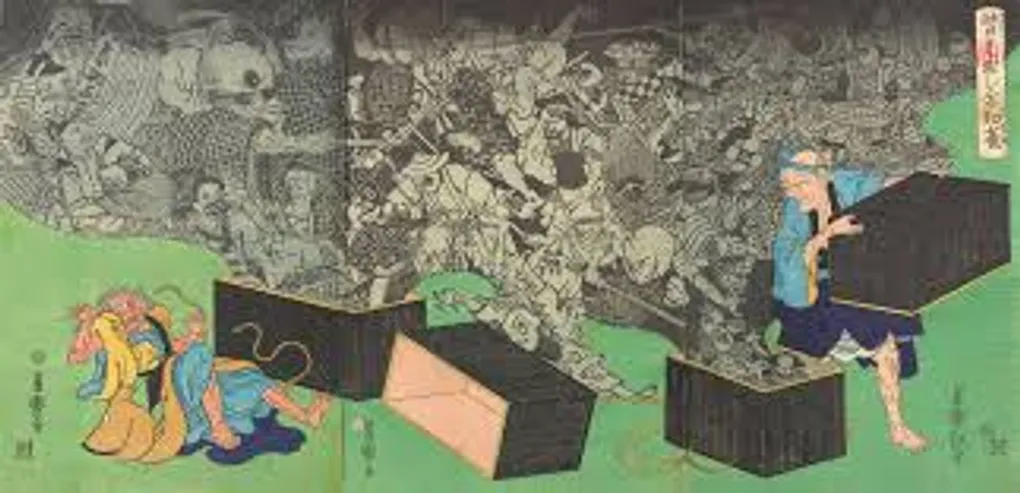
 「昔ばなし舌切雀」(The old Story of The Tongue Cut Sparrow) Utagawa Yoshimori 1864
Introduction
Though folktales in Japan have a very long history; most weren’t written down until Yanagita Kunio made a study of them in the 19th and early 20th centuries. Folk Tales in Japan exist to teach a lesson, as well as be entertaining. The lesson of Shita-kiri Suzume is that jealousy, greed, and meanness bring unhappy endings. While we do not know when exactly the story was first told; we do know that in the Edo Period, block prints like the one above, were printed depicting parts of these stories, knowing that the viewer would be able to supply the context.
In the early 20th Century Yanagita-sensei set out to write down the folktales of the rural people that he visited as a part of his job for the Ministry of Agriculture. They had not been written down prior to this, in part, because the Japanese school system, and modern ideas of scholarship, did not exist before the 1870s in Japan. Prior to this the topics for education were Confucian morality, arithmetic, calligraphy, military strategy, and martial arts for the warrior caste.(Dore) Yanagita-sensei found that it was predominantly older women who kept and told the stories.(Yanagita, xxi) He also found that each region where the story was told had slight variations, yet kept the same structure and message.(Yanagita, 130)
Yanagita Kunio
Yanagita-sensei is regarded as the father of Japanese Folk studies. He was born Matsuoka Kunio in 1875, at 19 years of age he passed his entrance exam to the First Higher School in Tokyo, a very prestigious prep-school. He then attended the Tokyo Imperial University (東京帝國大學 Tōkyō teikoku daigaku). And was appointed to the Ministry of Commerce and Agriculture in 1901. While travelling for his work with the Ministry, he took to taking detailed notes about what he saw and heard. In 1910, he published Tono Monogatari (Tales of Tono). Shortly thereafter he gathered a team of people to travel Japan and gather folktales. In 1914, he was appointed Chief Secretary of the House of Peers. In 1935, he published the first volume of the Nihon no Mukashi Banashi (Japanese Folk Tales) which became the standard for folk research in Japan. Yanagita was awarded many honours for his work in the preservation of this aspect of Japanese culture including: The Asahi Cultural Award (1941), membership in the Japan Art Academy, and The Order of Cultural Merit (1951). (Yanagita, and Hagin, vii - xii)
Story Summary
Once upon a time there was a kind old man and a greedy, mean old woman. The old man kept a pet sparrow. One day the old woman after finding that the sparrow had eaten her rice paste, grew angry, cut the sparrow’s tongue out, and drove it off. The old man came home to find his sparrow not there. After the woman told him what happened, the man goes to find the sparrow. After looking for a while he was lead to the house of the sparrow. She welcomed him, feed, and entertained him. After a while, the man told them that he had to go home. The sparrows offered him a parting gift, the choice of either a large box, or a small box. He chose the small box, and walked home. Upon getting home the old woman demands to know where he had been. The old man told the woman where he had been, and they opened the box together, and find gold, silver, coral, and fine clothes. The old man let slip that he had a choice of boxes. The old woman got angry and demanded to know why he took the small box, then resolved to go to the sparrow herself. Upon reaching the sparrows place, the old woman demanded the sparrow give her the large box. The old woman got tired on the way back and sat down, while sitting down she decided to open the box. Out of the box sprang snakes, spiders, and ghosts. The old woman was scared stiff, and ran away screaming.(Boutwell)
The Piece
Shita-kiri suzume, is considered by Asakura Haruhiko to be one of the 5 Great Folktales saying ““ごだいおとぎぱなし(五大御伽話)。五大昔話ともいう。桃太郎、猿蟹合戦、舌切雀、花咲爺、かちかち山の五話”[The Five Great Old Stories, (The Five Great Old Stories written in Kanji), Also called the Five Great Folk Tales: Momotaro, The Monkey-Crab battle, The Tongue-Cut Sparrow, The Old Man who caused dead trees to bloom, and the Fire Crackling Mountain](Asakura, 198) The earliest text I have been able to find of Shita-kiri suzume was published in 1880. However Yanagita-sensei asserts that it is a genuine folk tale, unlike stories like Kintaro written in the Muromachi Period (14th - 16th Century).
During his collection of tales Yanagita-sensei found Shita-kiri Suzume told in many places. In the section of his book Nihon no Mukashi Banashi regarding Shita-kiri Suzume he names the following provinces: Fukui, Ishikawa, Kumamoto, Niigata, and Ōita provinces.
 Map of Japan Highlighting the places where versions of the story were recorded. Map of Japan Highlighting the places where versions of the story were recorded. |
|---|
These folktales have many variations after having been told for centuries. The variations found in Shita-kiri Suzume are interesting, because the things which change can drastically affect the tone of the story. In one version the old woman gets angry over laundry starch, in another the sparrow eats a rice dessert called dango.(Yanagita, 130) In another version of the story the old man encounters several other people who help him find the sparrow, after asking him for help in specific tasks. (Yanagita, 130) There are also a few ways that I have found for the story to end. In one the old woman goes crazy and runs off.(Boutwell) In another, she is scared stiff and dies, or is eaten by spirits(Griffis, 30-36), and in yet another she goes home to her husband and tries to blame her troubles on the sparrow, only to have her husband rebuke her.(Ozaki, 12-25)
My Performance
I will be reciting the story in English first. This is so that the audience, my judges, can understand the story, and experience it as a native speaker of Japanese would, listening to it being told. The English recitation will keep as much as possible the same form as the original Japanese. Endeavouring to keep Japanese set phrases, and the feel of the story in its native language. I will then read the story in Japanese, and comment on things in the Japanese which do not translate well into English.
I am choosing to read, and give commentary on the story, as it allows me to bring Shita-kiri Suzume to life for my audience. By giving commentary on word choice, levels of formality, and tone I feel that I can let the audience see some of the nuances that would be obvious to the native speaker hearing the story. Allowing the audience to become more a part of the story, and setting.
I chose this piece because I find both the story and the array of variants interesting. This multitude of endings means that I can make the story appropriate for many audiences. It also means that I can tell the same story a few different ways, allowing me to change it up for audiences that have heard it before. I also delight in a challenge, this piece is both challenging to research, as not much has been written about it save Yanagita-sensei’s work, and requiring me to improve my Japanese to the point of being able to put together what is being talked about.
References
Asakura, Haruhiko. 神話伝説事典 (The Dictionary of Myths and Legends). 東京(Tokyo): 東京堂出版 (Tokyo-do Publishing), 1968. Print.
Boutwell, Clay, and Yumi Boutwell. Japanese Reader Collection Volume 5: Shitariki Suzume ; plus Kobutori Jiisan. Place of publication not identified, Kotoba Books, 2014.
Dore, R P. “The Legacy of Tokugawa Education.” Changing Japanese Attitudes Toward Modernization, Princeton University Press, Princeton, NJ, 1965, pp. 99–131.
Griffis, William Elliot. Japanese fairy world: stories from the wonder-Lore of Japan. Schenectady, NY, James A. Barhyte, 1880.
Ozaki, Yei Theodora. The Japanese fairy book. Archibald Constable and Company, 1903.
Piggott, Juliet. Japanese mythology. London, Chancellor Press, 1997.
Yanagita, Kunio, and Fanny Hagin. Mayer. The Yanagita Kunio guide to the Japanese folk tale. Bloomington, Indiana Univ. Press, 1986.